TRISO Fuel Qualification
TRISO fuel qualification is a critical element of high-temperature gas-cooled reactor (HTGR) deployment.
Within Advanced Reactor Technologies – Gas-Cooled Reactors, this page provides an overview of the tristructural isotropic (TRISO) fuel form and the role of qualification data in supporting reactor design, safety analysis, and licensing. More detailed information on TRISO fuel development and qualification activities is made available through the Advanced Fuels Campaign.
What is TRISO fuel?
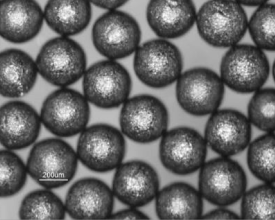
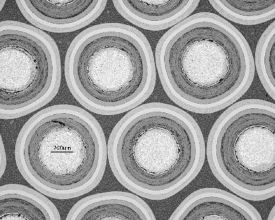
TRISO fuel is an advanced coated-particle fuel form in which each microscopic fuel kernel is surrounded by multiple engineered coating layers that provide fission product retention and structural robustness. Unlike conventional fuel systems that rely primarily on a cladding tube as the main fission-product barrier, TRISO fuel relies on the particle coatings as a key containment function.
Each TRISO particle is roughly the size of a poppy seed and functions as an independent micro-containment system.
TRISO particles are typically embedded in a graphite-based matrix to form one of two common fuel forms:
- Cylindrical fuel compacts, often associated with prismatic HTGR concepts
- Spherical fuel pebbles, often associated with pebble-bed reactor concepts.
How TRISO fuel is made
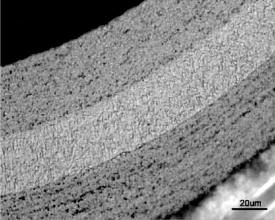
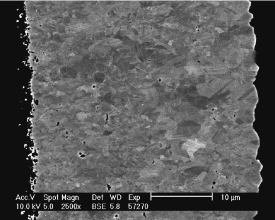
A standard TRISO particle consists of the following layers, listed from the center outward:
At a high level, TRISO fuel manufacturing includes kernel formation, coating deposition (typically using chemical vapor deposition processes), and fabrication into fuel compacts or pebbles, with quality control applied at each stage.
In U.S. Department of Energy programs, TRISO fabrication was progressively scaled from laboratory to engineering scale through successive experiments, with ongoing improvements aimed at reducing coating defects and tightening property distributions.
Why TRISO fuel matters and how it is qualified
Tristructural isotropic (TRISO) fuel supports advanced reactor and microreactor concepts by combining high-temperature capability and robust fuel performance with a qualification dataset needed for licensing.
Its design enables high outlet temperatures for efficient electricity generation and industrial heat uses, and its coated-particle structure contributes to robust behavior under off-normal and accident-relevant conditions.
In U.S. Department of Energy fuel qualification programs, TRISO fuel has been evaluated under representative reactor conditions through irradiation testing, post-irradiation examination, and safety testing. Qualification goals include high burnup levels and assessments of fission product retention at elevated temperatures.
The data generated from these activities contribute to a baseline fuel performance and qualification dataset that informs design, safety analysis, and licensing of gas-cooled reactor concepts.
INL's role
The Idaho National Laboratory supports the U.S. Department of Energy and national stakeholders by conducting and integrating TRISO fuel research and qualification activities such as these:
- Irradiation testing, post-irradiation examination, safety testing, and reporting
- Irradiation experiments conducted in the Advanced Test Reactor (ATR), including experiment design, monitoring, and analysis
- Post-irradiation safety testing and fission-product release measurement at elevated temperatures
- Data integration and analysis to support licensing-relevant fuel performance datasets
Learn more about fuel qualification
For a deeper understanding of TRISO fuel fabrication, testing, and qualification activities, including detailed experiment results and fuel performance data, visit the Advanced Fuels Campaign (AFC) website.