
Irradiation experiments
Advanced Graphite Creep program
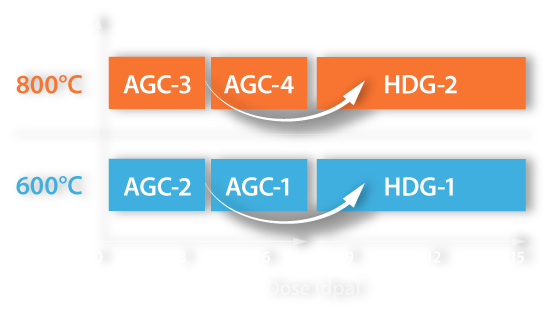
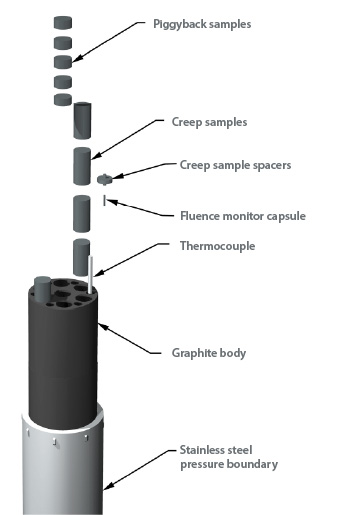
The Advanced Graphite Creep (AGC) program is the graphite irradiated material property testing program of the U.S. Department of Energy – Advanced Reactor Technologies (DOE-ART) Graphite Research and Development program. The Baseline program provides a large database of unirradiated material property data for each of the graphite grades used within the AGC experiments. The major objective of the irradiation experiments is to provide irradiation creep data. This requires irradiating matched pairs of stressed and unstressed specimens. This is achieved using the axial flux symmetry in ATR, with a stressed specimen above the symmetry plane matched to an unstressed specimen placed below the symmetry plane. This arrangement is used in six channels around the periphery of a graphite experiment capsule, with a center channel used for additional unstressed specimens. Four irradiation experiments were completed under this program: AGC-1, AGC-2, AGC-3, and AGC-4.
In 2018, the DOE ART Graphite program approved a major design change to the AGC experiment, extending the neutron dose range from 0–7 dpa to 0–15 dpa — a dose range more pertinent to current HTR designs. Click here to learn more about the High-Dose Graphite (HDG) Irradiation Experiments.
Baseline Graphite Characterization Data Portal
An interactive baseline graphite characterization data portal is available to registered users. Click below to access the baseline data portal, powered by SAS Visual Analytics.
High-Dose Graphite (HDG) experiments
The DOE-ART Graphite program approved a major design change to extend the neutron dose range of the Advanced Graphite Creep (AGC) experiments from 0–7 dpa to 0–15 dpa, a range more relevant to current high-temperature reactor (HTR) designs. This higher dose range extends graphite behavior beyond turnaround dose levels and into the tertiary creep regime.
To achieve this, the AGC-5 and AGC-6 irradiation capsules — originally planned for irradiation at VTHR conditions of 1,100°C — were repurposed to re-irradiate previously tested specimens:
AGC-5 → High Dose Graphite-1 (HDG-1):
Re-irradiation of AGC-2 specimens at a nominal temperature of 600°C
AGC-6 → High Dose Graphite-2 (HDG-2):
Re-irradiation of selected AGC-3 and AGC-4 specimens at a nominal temperature of 800°C
Following irradiation, all HDG specimens will undergo a second post-irradiation examination (PIE) to assess changes in material properties at higher dose levels.