To support graphite qualification, advanced characterization techniques are used to examine microstructural features across relevant length scales, providing insight into fabrication-related variability and providing material response to service conditions.
High-resolution transmission electron microscopy (HR-TEM) is one technique used to examine microstructural features from the atomic to the nanoscopic scale and to support understanding of how fabrication history, thermal exposure, and irradiation influence graphite behavior.
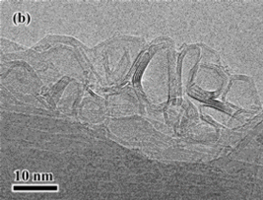
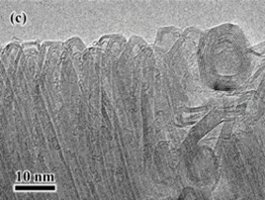
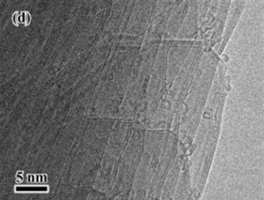
The HR-TEM micrographs below illustrate microstructural changes observed in the nuclear graphite grade IG-110 following thermal annealing. These observations provide insight into the degree of graphitization, defect structures, and local crystallite morphology that can influence graphite performance under reactor conditions.
Please refer to Johns, et al. (2022) for more information.

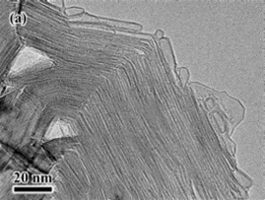 The edge of an annealed specimen where fullerene-like structures are abundant.