Experimental validation
Produce, collect and organize data
Experimental validation activities focus on producing, collecting, and organizing high-quality data needed to validate HTGR modeling and simulation tools. This work includes testing reactor components and studying their performance to provide reliable benchmarks for designers, analysts, and regulators.
The need for experimental data is identified using Phenomena Identification and Ranking Tables (PIRTs), which prioritize phenomena based on relevance and knowledge gaps. National laboratories, regulatory bodies, and industry stakeholders use the resulting data to confirm analysis and optimize reactor designs.
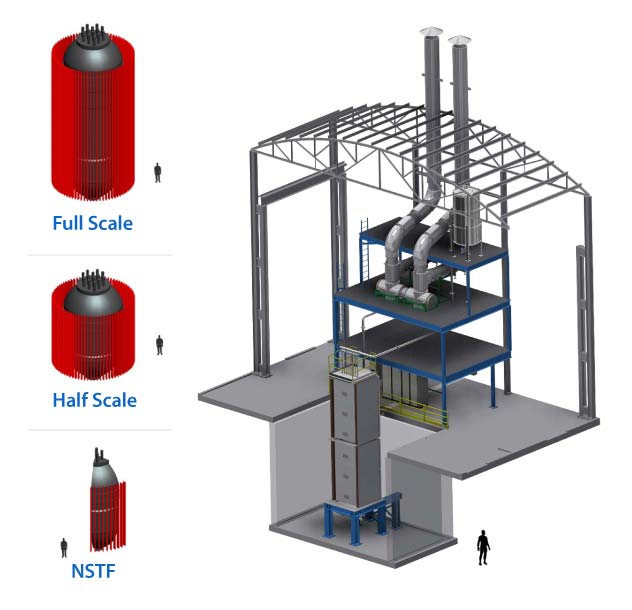
Experimental data are generated using scaled test facilities, including the High Temperature Test Facility (HTTF) and the Natural Convection Shutdown Heat Removal Test Facility (NSTF). In addition, data from the Nuclear Energy University Program (NEUP) are collected and organized into benchmark datasets to support validation activities.
NSTF facility
Argonne National Laboratory’s Natural Convection Shutdown Heat Removal Test Facility (NSTF) is a large-scale experimental facility used to evaluate passive decay heat removal systems relevant to advanced reactors.
NSTF supports the following:
- Examination of passive safety concepts
- Exploration of alternative reactor design approaches
- Generation of benchmark data for validation of advanced analysis tools.
Since 2005, NSTF has supported large-scale testing under the DOE Office of ART program. Data generated through NSTF are compliant with NQA-1 (2008 with 2009a) requirements and are suitable for reactor design and licensing applications.