
Reactor analysis
Identifying key phenomena for HTGR deployment
Reactor analysis activities apply verified and validated computational methods to evaluate HTGR behavior under normal operating conditions and accident scenarios. Analysis tools must represent reactor response across the full calculational envelope.
Using Phenomena Identification and Ranking Tables (PIRTs), key physical phenomena are identified and prioritized. These phenomena guide the development, improvement and application of simulation methods used to support experiments, optimize designs, and inform regulatory evaluation.
General pebble bed reactor (GPBR-200)
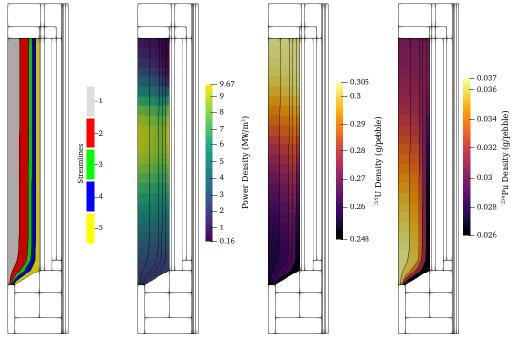
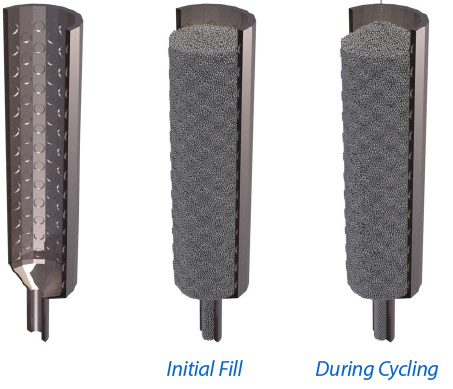
The GPBR-200 provides a representative reference case for implementing and evaluating reactor analysis methods for pebble-bed HTGR concepts. Based on current and historical pebble-bed reactor designs, GPBR-200 supports these:
- Benchmarking of reactor physics and thermal-hydraulic behavior
- Implementing and testing analysis methodologies
- Design optimization studies
This reference configuration enables a consistent comparison of analysis tools against a common reactor model.
HTTR reactor analysis
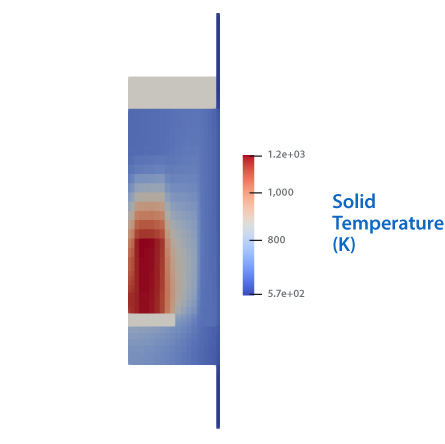
Loss-of-Forced-Cooling (LOFC) experiments conducted at the High Temperature Engineering Test Reactor (HTTR) in Japan provide valuable experimental data demonstrating the passive safety characteristics of HTGR systems.
Reactor analysis activities leverage these experiments to validate modeling tools and methods, including:
- Developing coupled Pronghorn–Griffin simulation models
- Comparing modeled results with measured experimental data across multiple LOFC tests
- Validating analysis approaches across multiple LOFC tests
The Pronghorn–Griffin coupled models have demonstrated good agreement with experimental measurements for the three HTTR LOFC tests reported to date, supporting confidence in their application to the HTGR transient analysis.
Why reactor analysis matters
Reactor analysis provides the technical foundation needed to apply validated simulation tools with confidence in HTGR design and safety assessments. By linking experimental data with advanced modeling methods, these efforts support the following results:
- Improved understanding of reactor behavior during steady-state and transient conditions
- Developing defensible models for regulatory evaluation
- Reducing uncertainty in safety analyses while maintaining appropriate safety margins