Graphite performance modeling
Simulate and predict graphite behavior
Graphite performance modeling uses computational methods to predict the behavior of nuclear-grade graphite under the extreme conditions encountered in advanced reactors such as, high temperatures, mechanical stresses, and neutron irradiation. These models are essential to understanding and predicting how graphite components, such as moderator blocks and reflectors, will perform over a reactor’s operational lifetime.
Modeling activities integrate empirical data, irradiation test results, and material property measurements to inform design, safety analysis, and graphite qualification efforts.
Behavior of irradiation and temperature
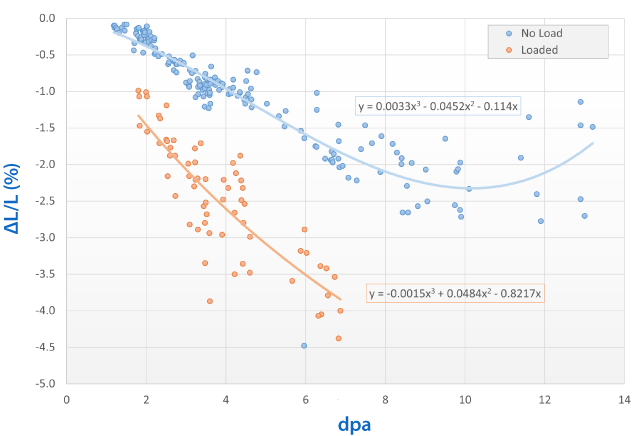
Graphite performance models are used to describe irradiation-induced dimensional change across a range of graphite grades and operating temperatures. The figure shown illustrates empirical models of PCEA from AGC-1 through AGC-3 and Innograph. The loaded specimen tested through the AGC programs were a one-of-a-kind test designed to demonstrate creep behavior in-situ.
These modeling approaches support interpreting experimental data and extrapolating graphite behavior to reactor-relevant conditions.
Modeling reactor-relevant conditions
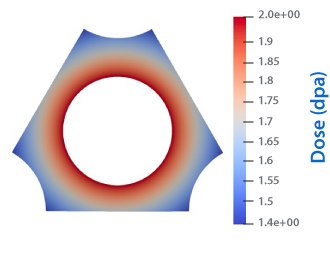
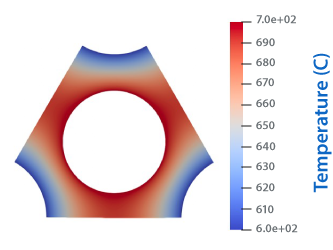
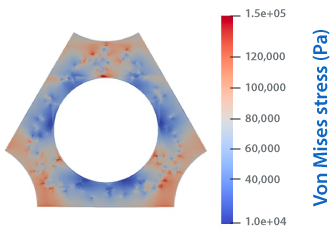
In addition to irradiation effects, graphite performance models are used to evaluate combined reactor-relevant conditions, including neutron fluence, temperature, and mechanical stress that influence graphite behavior during operation.
The profiles shown illustrate representative fluence (left), temperature (center), and stress (right) distributions for graphite components under reactor conditions. These simulations support interpreting experimental data and assessment of component-scale performance relevant to graphite qualification.
Source: TBD