
Oxidation
Understanding graphite oxidation behavior
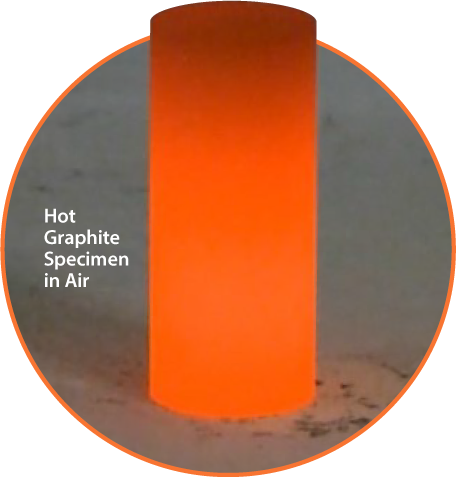
The graphite qualification oxidation area focuses on testing and understanding how nuclear-grade graphite reacts with oxidizing environments, such as air or carbon dioxide, at high temperatures. Oxidation is a critical consideration for ensuring the safety and reliability of graphite components in advanced reactors, particularly in accident scenarios where the graphite may be exposed to oxygen or other oxidizing agents.
Oxidation behavior is influenced by several key factors:
Temperature
Oxidation rates increase significantly at higher temperatures, particularly above approximately 400–600°C, when chemical reactions become more rapid.
Microstructure
Graphite with higher porosity or larger surface area is more susceptible to oxidation due to increased exposure to oxidizing gases.
Gas composition
The type and concentration of oxidizing species (e.g., O₂, CO₂, H₂O) play a major role in determining oxidation behavior.
Irradiation effects
Neutron irradiation can introduce defects in graphite that may alter oxidation behavior.
In addition to studying the oxidation behavior of graphite, it is essential to evaluate how oxidation affects the material’s strength properties. Following oxidation, specimens are trimmed and subjected to compression testing to assess the influence of temperature and mass loss on compressive strength. The plot illustrates the variation in compressive strength as a function of mass loss and temperature. Small markers represent individual data points, while larger markers indicate the average values for each subset.
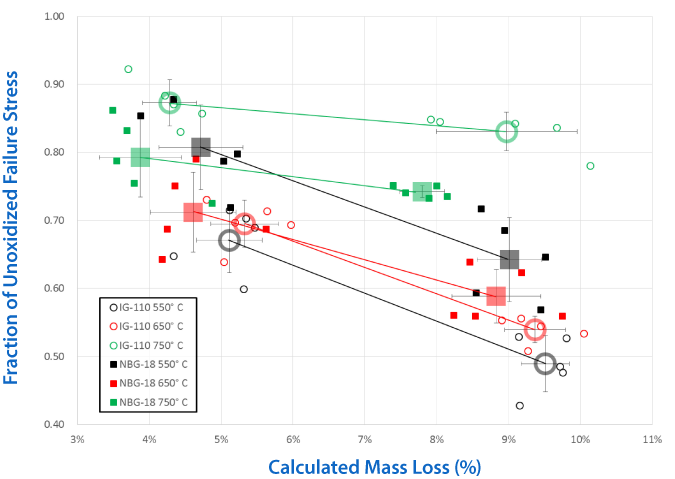
Source: Windes, W., et al. 2019. “The Degradation of Strength under Varying Oxidizing Conditions for Nuclear Graphite.” INL/EXT–19-53623-Rev000. https://www.osti.gov/biblio/1512803