Baseline characterization
Graphite Unirradiated MaterialProperty testing program
The Baseline program is the unirradiated graphite material property testing program within the U.S. Department of Energy – Advanced Reactor Technologies (DOE-ART) Graphite Research and Development effort. It provides a comprehensive and statistically significant database of the physical, mechanical and thermal property data for several grades of graphite used in the irradiated Advanced Graphite Creep (AGC) experiments.
The Baseline program establishes accurate material property values across multiple billets and production batches for each graphite grade. These data enable direct comparison with irradiated material property measurements from AGC experiments, supporting identification of irradiation-induced changes in graphite behavior.
Baseline data is also used to evaluate the effects of oxidation and interactions with other materials, such as molten salts, and to support the completion of the Material Data Sheets specified in the ASME Boiler and Pressure Vessel Code (BPVC) for nuclear graphite components (Article HHA).
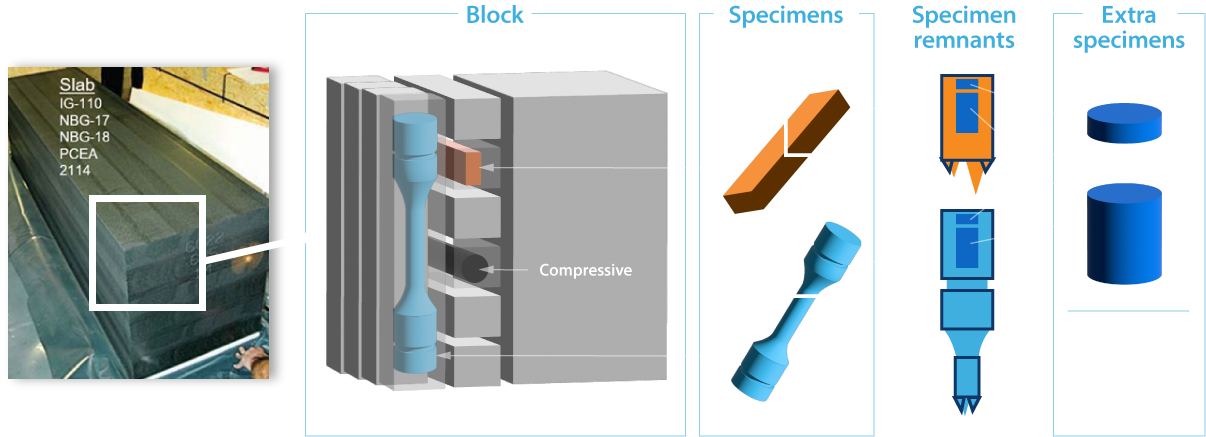
The samples are machined from as-manufactured billets and are carefully documented to track their location within the billet and their orientation relative to the grain structure. The Baseline Characterization Program currently tests the following:
- Tensile strength
- Brazillian split disc testing (tensile strength approximation)
- Compression strength
- Flexural strength
- Thermal diffusivity (laser flash analysis)
- Coefficient of thermal expansion up to 1000℃ (dilatometry)
- Elastic modulus
- Sonic velocity
- Fundamental frequency.
Other tests, such as wear, hardness, impact toughness, and high-temperature mechanical testing, are being investigated for graphite and graphite matrix materials (used in tristructural isotropic pebbles).